Wednesday, February 23, 2011

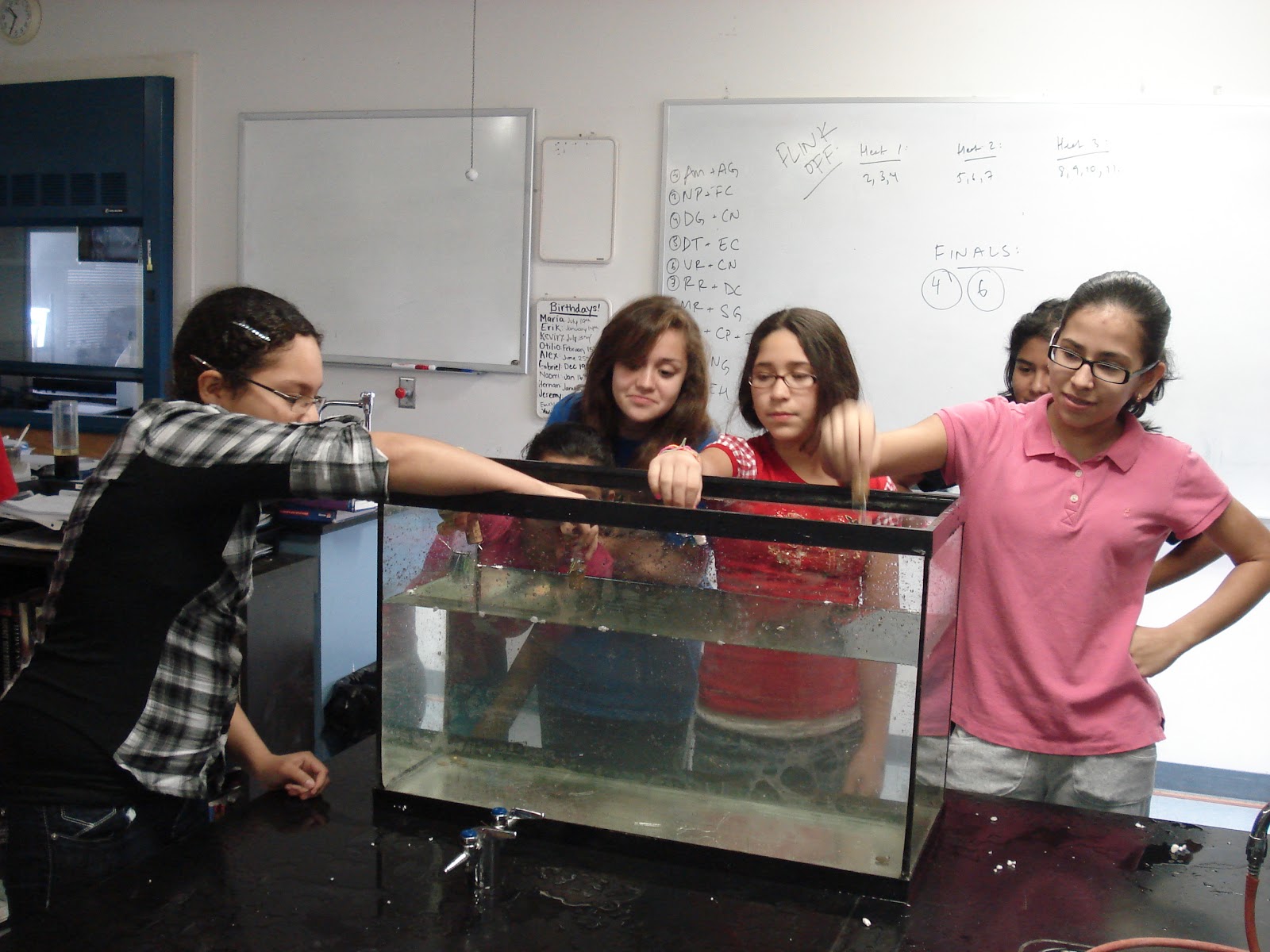
1st Annual Flink Off!


One of the few things I remember from middle school science is making Flinkers - objects that neither float nor sink in water, but rather stay suspended in between. Since we just finished our unit on density, I decided it was a good idea to have our 1st Annual Flink Off. The 6th graders were put into teams, given corks, styrofoam peanuts, pennies, paper clips of different sizes, and were challenged to make the best Flinker possible. At the end of the second day of designing Flinkers we had a competition to declare a winner. Even I entered a Flinker in the Flink Off, which seemed to raise the stakes as far as the students were concerned.

I've been trying to do these hands-on, problem-solving, group activities on a weekly basis this semester and so far they've been great. We had a lot of good cooperation and clever engineering going on during the last two days, and my hope is that, like me, they will never forget making Flinkers.

Check out the video of the Flink Off Finals. Not the best quality, but hopefully you can get a sense of how much fun we had as a class.

Saturday, February 5, 2011

Goal #2: Hands-On Learning

Designing Anemometers

Is this what learning looks like?
Award: Most Functional Design
Award: Most Creative and Unique Design

Slowly but surely I've been trying to make good on my goals for this semester. Unfortunately, I haven't been as prepared for classes as I would like - if anything I've been doing more last-minute planning after taking on a third prep for a couple weeks - but I have been doing more hands-on activities in 6th grade science and I have been 'taking on more', for better or for worse. Here, I want to focus on my science class - in a future post I will discuss the pros and cons of stretching yourself too thin.
About two weeks ago I committed (or re-committed) to making my science class fun and hands-on, which means more experiments, more activities, more projects. It began with a 3 day project where the students were given an array of materials from the science closet and told to build an anemometer - a wind-speed measuring device. I didn't quite know what to expect from the students, I didn't know if this simple engineering project was over their heads or not, or whether they would enjoy it. I went with the 'less is more' approach and gave them minimal guidance, basically just handing them a box of materials and telling them to build something that can compare wind speeds. It turned out to be one of the most fun (hopefully educational?) experiences of the year.

To be honest, the only drawback was watching some students struggle with the problem to the extent that they felt unintelligent. I tried to help them troubleshoot their designs, but some of the students would just give up at the first sniff of adversity. This mostly occurred in the dysfunctional groups where, instead of all three students working together, each student worked individually doing three times the work. Next time I should be more clear about what it means to 'work in groups'.

One other quick note for first-year teachers to keep in mind: Be transparent with your students. One of my concerns for doing  more hands-on experiments and activities with the 6th graders was that they would get rowdy, out of hand, and in some cases be  unsafe. In response, I sat them down, had them elucidate what my concerns might be, and made them a deal: We would do more fun experiments if they promised to focus and listen whenever I spoke. So far, so good, knock on wood. The students were pretty amicable to this negotiation, so I would highly recommend just being honest with your class if you have any concerns.

Monday, January 17, 2011

Online Education Resources / Conversations

Even though my contribution was used to show a counterexample of what I was trying to show, it was still neat to be acknowledged online.


One thing I learned early on in my year at Chinquapin is that teaching is too difficult an endeavor to take on in isolation. For all teachers, but especially first year teachers, relying on colleagues in your school and  outside of your school is imperative. Often, the latter is easier because of the vast amount of information available online and the impersonal nature of the internet. Until I started looking for science and math videos, blogs, and projects on the internet, my lesson planning was incredibly difficult. Plus, keeping updated on the education conversations happening online gives me an idea of what types of topics are being discussed in progressive education circles and reminds me that I am not alone in struggling to find effective classroom practices. Reading and researching current discussions in education is the best way for me to challenge and broaden my own teaching practices, and if you are not constantly trying to become the best teacher you can be, then why bother doing it at all?

The other great thing about the internet, that makes it superior to print resources, is that you can participate in the discussions rather than just observe them. Even though I've been teaching math for less than a year, my online presence is just as legitimate as 99% of math teachers in the world. For example, I have been posting and commenting and e-mailing Dan Meyer, a leader in the math education field, for the past few months and I have been amazed at how accessible his blog has been. I was particularly excited to see some of my comments on his posts elicit responses from other readers, and one of my e-mails to him was even posted on his blog (which was a secret goal of mine this year...).

So if you are a new teacher (or a new anything, for that matter) don't be afraid to get your hands dirty and jump into the online conversation with the 'experts,' it's definitely one of the best things that has happened in my brief teaching career so far.
Published with Blogger-droid v1.6.5

Saturday, January 8, 2011

Follow Up to "Discipline"

Extra Credit Problem #7 (click on it for a larger version)
Earlier this year I gave my students an extra credit sheet of math problems that they could do in class or on their own time to help their grade. My motive was to give the students something to do when they finished classwork to prevent chit-chat, and also give the students who were doing poorly on homework an opportunity to improve their grade. In the words of one of my 8th graders, this turned out to be an "Epic Fail".

Transparency is important in teaching, and for me that means talking about my failures in addition to my successes. None of the 14 students in my class handed in the extra credit, not even after I told them to hand in what you have and I'll give credit for any correct answers. In other words, more of my friends that read this blog got credit for doing the '9 dots problem' than any of my students...

So to all the future teachers / first year teachers out there, don't be afraid to try something and fail. In fact, many of the things you try probably will fail. It will all be worth it, though, when something you try succeeds. I'm doing a project with the 6th grade science class next week that challenges them to make their own anemometer (wind speed measuring device). We'll see how it goes, cross your fingers...

Wednesday, January 5, 2011

Second Semester Goals

After a restful holiday vacation, I have come back to Chinquapin reinvigorated for the upcoming semester. While the first semester was great, and I am happy with how my classes went and my growth as an educator, I know I have a long way to go. The most important quality in a good teacher, is being a good learner, and anyone who wants to be successful in education is going to have to be an excellent student of the profession. To that end, here are my goals for this upcoming semester:

1. Be more prepared. This goal is self explanatory, but there is no better feeling than leaving a classroom and knowing that you actually taught something and hopefully left them with more questions than answers. I can count on one hand the number of great lessons I taught, and maximizing those great lessons is the best way to get better. Being prepared is the best way to maximize great lessons. While the new year is only two days old, so far, so good...

2. Do more labs in science class. Labs are what the students enjoy the most, and science is meant to be a hands-on exploration of the world around us. Last semester I often got caught up in the details of teaching facts, and while facts have a time and place, I think 6th grade science should emphasize building curiosity and a joy of learning. Having an experiment-based science class is the best way to accomplish this.

3. Take on more. I'm not sure what form this goal will take, but I don't want to leave Chinquapin thinking I did an 'okay' job. I'm only here for a year, so there is really no point in 'leaving anything in the tank', so to speak. Perhaps after taking on too many responsibilities I'll reach my breaking point, but how will I know what that point is if I don't push myself to do everything I can to help this community. This goal definitely encompasses the other two, but is more of a general reminder to work my butt off.


The Fellows

This post is literally just a picture of the other Fellows I work with. More exciting thoughts to come when I am less tired...

Monday, December 6, 2010

Social Responsibility?

If you are a first year teacher, especially for those in a one-year internship/fellowship program, you are likely busy planning lessons, grading, and trying to maintain some sort of life outside of school. On top of that, before you know it, you need to start thinking about your plans for next year. This generally entails a mountain of cover letters, job applications, and most importantly, self-reflective questions about where you want your career to go and what type of school you want to commit to.

No longer is a teacher's decision simply Private School vs. Public School. Nowadays, there is an incredibly wide spectrum of schools available to work at, ranging from elite private schools (think Phillips Exeter) to underachieving public schools (think urban, minority, impoverished) to everything in between (charter schools, magnet schools, Waldorf schools, and other really unique school models like this one). At this point in my nascent career, I'm going to commit to the school that provides the best opportunity for me to develop as an educator over the next few years. However, determining what type of school this might be is nontrivial.

When I write my cover letters for elite private schools, I get extremely excited about the prospect of having Promethean boards in my classrooms, for example, and I really think my teaching would benefit from having so much technology readily available to me. Plus, in the classroom, I would enjoy the curricular freedom that a private school generally allows (for example, next semester at Chinquapin I am teaching a 5 week course on current events in Biology).

On the other hand, when I write my cover letters for urban charter schools, I get extremely excited about the prospect of helping close the achievement gap and building relationships with students who may not be getting a lot of educational support elsewhere. While it is true that every student can benefit from a good teacher, students from urban, minority backgrounds need good teachers, while students from affluent families that attend elite prep schools will likely be 'fine' either way.

So my question becomes: To what extent do I, as an educated, compassionate member of society, have a social responsibility to work where good teachers are needed most and where I could have the greatest positive effect on society?

While my main concern is teaching, this question easily applies to all professions, most notably medicine. To what extent do doctors have the responsibility of working in Africa, for instance, where they could save hundreds of lives, instead of America, for instance, where the same amount of effort may only save one?

Thoughts?