From a teaching perspective, this project might have also been the easiest/best thing I did all year. Prep time was minimal after the initial gathering of supplies and project assignment, and grading was even easier than that because all the groups did such a good job overall.

Sunday, May 29, 2011
Rube Goldbergs

Wednesday, May 4, 2011
The End of the Year...
With the end of the year in sight, I offer a few reflections...
1. I wonder if any teacher gets to the end of the year, turns around, looks back on what they've accomplished, and says, "Wow, I did everything I planned on doing!" Instead, what I feel like asking is, "Wow, did I accomplish anything I wanted to?" Overall the year has been as successful as I probably could have hoped for, but that certainly doesn't mean I did everything I hoped to. There are still those students in Algebra that are unprepared for 9th grade and those students in Science that haven't developed a passion for the subject yet. There are still those project ideas that I didn't get to and those activities I never did. There are still people - faculty and students - that I never got to know outside of the classroom or never had a 1-on-1 chat with. I guess that is what next year is for...
2. Finding a job is sort of hard. Last year when I was searching for a job, I stumbled upon Chinquapin and it has worked out wonderfully. I've really enjoyed my year, and while it has been exhausting at times, in retrospect I think I've grown a lot. This year I thought I was going to, once again, serendipitously find a job that I loved and everything would work out swimmingly... Not so fast. After applying to nearly 40 positions, interviewing on the phone with a bunch, interviewing in person with a handful, and constantly having my hopes dashed and revived, I've discovered what most adults probably already know - 'good jobs do not grow on trees'. While 'beggars cannot be choosers' I continue to be overly discerning during my search and remain optimistic that everything will work out. We'll see. If not, Mom and Dad, is my room still available?
3. For all of the college readers out there - the first year of life after college is whatever you make of it. I was afraid of leaving Williams and definitely have gotten nostalgic at times for the Purple Valley, but living on my own in a new city with new people doing something completely new has been... well... really new. What I loved about Williams was that there was a constant stream of stimuli always keeping you socially and intellectually engaged. If you constantly introduce new stimuli into your life after college, I think you'll find your first year to be incredibly rewarding - albeit difficult and tiring, but in the end, rewarding.
Friday, March 18, 2011
NSTA 2011

If I were to summarize my experience at the annual National Science Teachers Association (NSTA) conference in San Francisco in one word it would have to be: Overwhelming.
There were hundreds of presentations every day, thousands and thousands of people there, and somehow or another it still felt incredibly informative and personal. Some of the highlights were:
1. Hearing Jeff Goldstein speak about the 'journey of science' and the role that teachers play in this journey. It was incredibly emotional and definitely reenergized me to become the best science teacher I can be. At times during the grind of the year you forget why you wanted to be a science teacher and sometimes you lose sight of your goal - helping students discover the joy of science and unearth their inner scientists. Jeff Goldstein's talk was just what the doctor ordered, so to speak.
2. Bill Nye 'The Science Guy' also spoke at the conference. Enough said. Also, I got the sense that if I had stood up in the middle of his talk and shouted, "Bill Nye The Science Guy!" The entire crowd would have responded, "Bill! Bill! Bill! Bill!"
3. There was a really fun presentation on 8th grade misconceptions in science. Turns out I had a lot of the same misconceptions too. It was sort of embarrassing until I realized that most of the science teachers in the room had the same misconceptions... There must be some commentary here on the American science education system, but that is a post for another day.
Example: True or False. The yolk of a chicken egg is a really large cell nucleus.
4. Project-Based Learning / Inquiry-Based Learning / Project-Based Inquiry Science. It took me forever to figure out what this was exactly - even though everyone was talking about it at the conference - and eventually I just asked someone outright. He told me the definition was quite convoluted at this point and it was more of a working definition, and while all of the above-mentioned terms were different, they were related. Here's the best definition I could find. On the last day of the conference, I went to a round-table discussion on how successful these teaching methods have been in science classrooms and it was revelatory. It seems to make so much sense, I'm not sure why all schools aren't doing this. It definitely requires a lot of work on the front-end, but pays off incredible dividends on the back-end. I am convinced that this is the direction that science needs to take. Even though I was a science major in college, I didn't enjoy science in high school because it didn't appeal to the joy of exploration and joy of problem-solving that I experienced in Williams science classes. This teaching method is the best way to remedy the problem.
Answer to above question: False. A chicken egg is a really large cell, but the yolk is not the nucleus, it is a rich source of nutrients for the developing embryo. The nucleus is actually much, much smaller and located in the yolk.
Wednesday, February 23, 2011
1st Annual Flink Off!


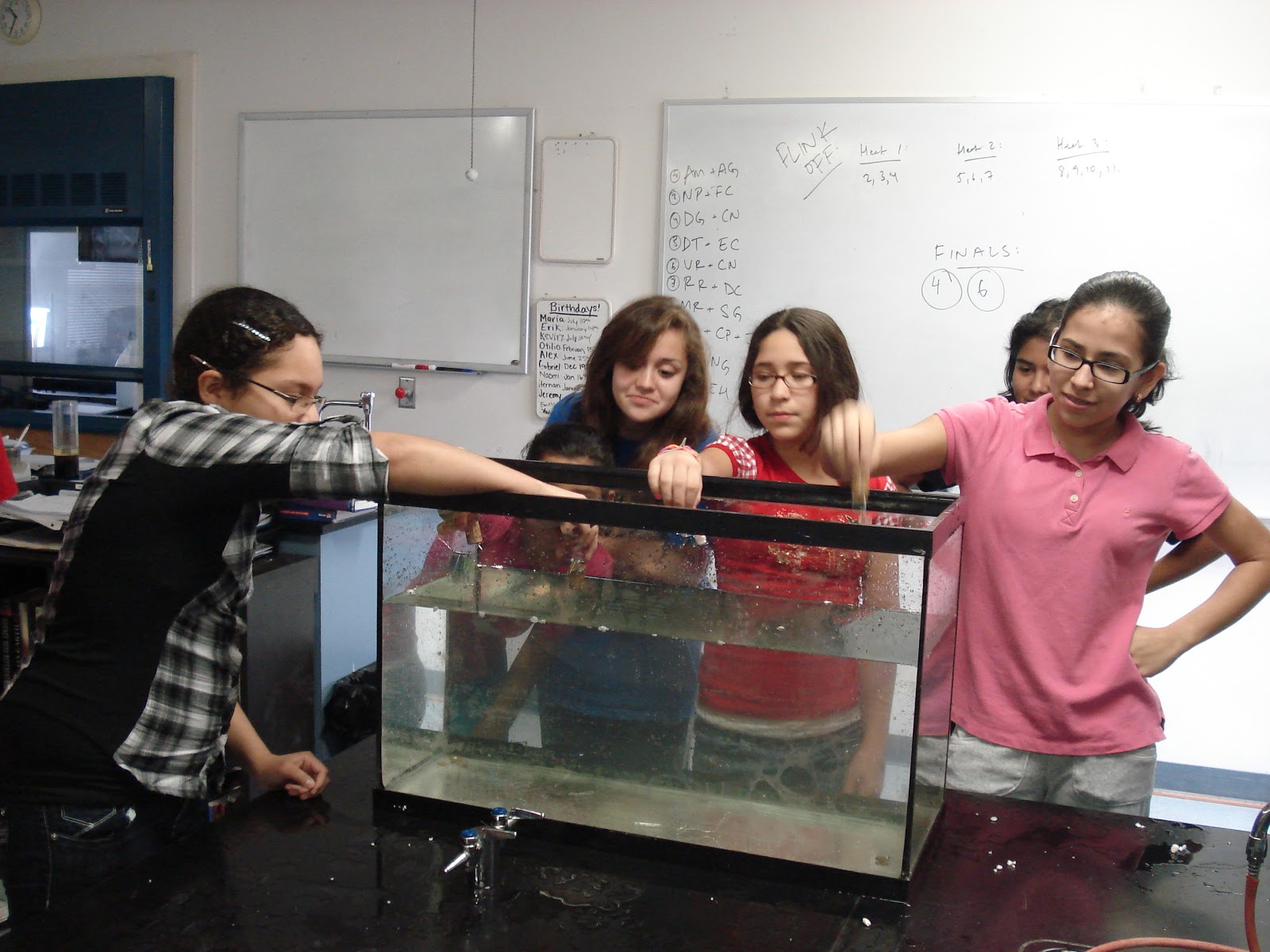
One of the few things I remember from middle school science is making Flinkers - objects that neither float nor sink in water, but rather stay suspended in between. Since we just finished our unit on density, I decided it was a good idea to have our 1st Annual Flink Off. The 6th graders were put into teams, given corks, styrofoam peanuts, pennies, paper clips of different sizes, and were challenged to make the best Flinker possible. At the end of the second day of designing Flinkers we had a competition to declare a winner. Even I entered a Flinker in the Flink Off, which seemed to raise the stakes as far as the students were concerned.
I've been trying to do these hands-on, problem-solving, group activities on a weekly basis this semester and so far they've been great. We had a lot of good cooperation and clever engineering going on during the last two days, and my hope is that, like me, they will never forget making Flinkers.
Check out the video of the Flink Off Finals. Not the best quality, but hopefully you can get a sense of how much fun we had as a class.
Saturday, February 5, 2011
Goal #2: Hands-On Learning
 |
| Designing Anemometers |
 |
| Is this what learning looks like? |
 |
| Award: Most Functional Design |
 |
| Award: Most Creative and Unique Design |
Slowly but surely I've been trying to make good on my goals for this semester. Unfortunately, I haven't been as prepared for classes as I would like - if anything I've been doing more last-minute planning after taking on a third prep for a couple weeks - but I have been doing more hands-on activities in 6th grade science and I have been 'taking on more', for better or for worse. Here, I want to focus on my science class - in a future post I will discuss the pros and cons of stretching yourself too thin.
About two weeks ago I committed (or re-committed) to making my science class fun and hands-on, which means more experiments, more activities, more projects. It began with a 3 day project where the students were given an array of materials from the science closet and told to build an anemometer - a wind-speed measuring device. I didn't quite know what to expect from the students, I didn't know if this simple engineering project was over their heads or not, or whether they would enjoy it. I went with the 'less is more' approach and gave them minimal guidance, basically just handing them a box of materials and telling them to build something that can compare wind speeds. It turned out to be one of the most fun (hopefully educational?) experiences of the year.
To be honest, the only drawback was watching some students struggle with the problem to the extent that they felt unintelligent. I tried to help them troubleshoot their designs, but some of the students would just give up at the first sniff of adversity. This mostly occurred in the dysfunctional groups where, instead of all three students working together, each student worked individually doing three times the work. Next time I should be more clear about what it means to 'work in groups'.
One other quick note for first-year teachers to keep in mind: Be transparent with your students. One of my concerns for doing more hands-on experiments and activities with the 6th graders was that they would get rowdy, out of hand, and in some cases be unsafe. In response, I sat them down, had them elucidate what my concerns might be, and made them a deal: We would do more fun experiments if they promised to focus and listen whenever I spoke. So far, so good, knock on wood. The students were pretty amicable to this negotiation, so I would highly recommend just being honest with your class if you have any concerns.
Monday, January 17, 2011
Online Education Resources / Conversations
 |
| Even though my contribution was used to show a counterexample of what I was trying to show, it was still neat to be acknowledged online. |
The other great thing about the internet, that makes it superior to print resources, is that you can participate in the discussions rather than just observe them. Even though I've been teaching math for less than a year, my online presence is just as legitimate as 99% of math teachers in the world. For example, I have been posting and commenting and e-mailing Dan Meyer, a leader in the math education field, for the past few months and I have been amazed at how accessible his blog has been. I was particularly excited to see some of my comments on his posts elicit responses from other readers, and one of my e-mails to him was even posted on his blog (which was a secret goal of mine this year...).
So if you are a new teacher (or a new anything, for that matter) don't be afraid to get your hands dirty and jump into the online conversation with the 'experts,' it's definitely one of the best things that has happened in my brief teaching career so far.
Published with Blogger-droid v1.6.5
Saturday, January 8, 2011
Follow Up to "Discipline"
 |
| Extra Credit Problem #7 (click on it for a larger version) |
Transparency is important in teaching, and for me that means talking about my failures in addition to my successes. None of the 14 students in my class handed in the extra credit, not even after I told them to hand in what you have and I'll give credit for any correct answers. In other words, more of my friends that read this blog got credit for doing the '9 dots problem' than any of my students...
So to all the future teachers / first year teachers out there, don't be afraid to try something and fail. In fact, many of the things you try probably will fail. It will all be worth it, though, when something you try succeeds. I'm doing a project with the 6th grade science class next week that challenges them to make their own anemometer (wind speed measuring device). We'll see how it goes, cross your fingers...
Wednesday, January 5, 2011
Second Semester Goals
After a restful holiday vacation, I have come back to Chinquapin reinvigorated for the upcoming semester. While the first semester was great, and I am happy with how my classes went and my growth as an educator, I know I have a long way to go. The most important quality in a good teacher, is being a good learner, and anyone who wants to be successful in education is going to have to be an excellent student of the profession. To that end, here are my goals for this upcoming semester:
1. Be more prepared. This goal is self explanatory, but there is no better feeling than leaving a classroom and knowing that you actually taught something and hopefully left them with more questions than answers. I can count on one hand the number of great lessons I taught, and maximizing those great lessons is the best way to get better. Being prepared is the best way to maximize great lessons. While the new year is only two days old, so far, so good...
2. Do more labs in science class. Labs are what the students enjoy the most, and science is meant to be a hands-on exploration of the world around us. Last semester I often got caught up in the details of teaching facts, and while facts have a time and place, I think 6th grade science should emphasize building curiosity and a joy of learning. Having an experiment-based science class is the best way to accomplish this.
3. Take on more. I'm not sure what form this goal will take, but I don't want to leave Chinquapin thinking I did an 'okay' job. I'm only here for a year, so there is really no point in 'leaving anything in the tank', so to speak. Perhaps after taking on too many responsibilities I'll reach my breaking point, but how will I know what that point is if I don't push myself to do everything I can to help this community. This goal definitely encompasses the other two, but is more of a general reminder to work my butt off.
The Fellows

Monday, December 6, 2010
Social Responsibility?
If you are a first year teacher, especially for those in a one-year internship/fellowship program, you are likely busy planning lessons, grading, and trying to maintain some sort of life outside of school. On top of that, before you know it, you need to start thinking about your plans for next year. This generally entails a mountain of cover letters, job applications, and most importantly, self-reflective questions about where you want your career to go and what type of school you want to commit to.
No longer is a teacher's decision simply Private School vs. Public School. Nowadays, there is an incredibly wide spectrum of schools available to work at, ranging from elite private schools (think Phillips Exeter) to underachieving public schools (think urban, minority, impoverished) to everything in between (charter schools, magnet schools, Waldorf schools, and other really unique school models like this one). At this point in my nascent career, I'm going to commit to the school that provides the best opportunity for me to develop as an educator over the next few years. However, determining what type of school this might be is nontrivial.
When I write my cover letters for elite private schools, I get extremely excited about the prospect of having Promethean boards in my classrooms, for example, and I really think my teaching would benefit from having so much technology readily available to me. Plus, in the classroom, I would enjoy the curricular freedom that a private school generally allows (for example, next semester at Chinquapin I am teaching a 5 week course on current events in Biology).
On the other hand, when I write my cover letters for urban charter schools, I get extremely excited about the prospect of helping close the achievement gap and building relationships with students who may not be getting a lot of educational support elsewhere. While it is true that every student can benefit from a good teacher, students from urban, minority backgrounds need good teachers, while students from affluent families that attend elite prep schools will likely be 'fine' either way.
So my question becomes: To what extent do I, as an educated, compassionate member of society, have a social responsibility to work where good teachers are needed most and where I could have the greatest positive effect on society?
While my main concern is teaching, this question easily applies to all professions, most notably medicine. To what extent do doctors have the responsibility of working in Africa, for instance, where they could save hundreds of lives, instead of America, for instance, where the same amount of effort may only save one?
Thoughts?
Monday, November 22, 2010
Owl Pellet Dissection
Preparing experiments for science class can often be a time-consuming and stressful experience for me.
Time-consuming because I have to gather the materials (which sometimes requires going out and buying them), prepare the lab and report sheets, and sometimes do a practice run of the experiment to make sure it works. Stressful because I have 21 sixth graders, many of whom have short attention spans and issues with listening and following directions, and only one of me to watch over everything. I essentially have to design the lab so that only I handle the expensive/harmful materials, which means when I am working with one group of three students, 18 others are more or less unsupervised...
The upside to all of this, however, is that the students absolutely love working with their hands and doing actual experiments. Today, for instance, we dissected owl pellets and identified the bones that we discovered. Except for one or two students, everyone was engrossed in the oddity of the owl pellets and the meticulousness required to separate the tiny bones.
The nice thing about doing experiments like this one in class is that it fulfills two of the most difficult requirements of a successful lesson plan:
The nice thing about doing experiments like this one in class is that it fulfills two of the most difficult requirements of a successful lesson plan:
1. It engages a students curiosity and keeps them interested in the lesson.
2. It meets each individual student at their particular intellectual level.
In every class you will have students that are at different intellectual levels - particularly in the sixth grade at Chinquapin where students come from a wide range of educational backgrounds. One of the marks of a successful lesson is that each individual student can engage with the material at the appropriate level for him or her so that it is challenging enough to help them learn, but not so challenging that they are discouraged. Labs and experiments are so nuanced that they have many layers of intellectual rigor. For example, some of the students were simply intrigued by the sight of rodent bones, tried their best to identify them, and made basic connections between their findings and the food webs we have been discussing in class. Other students, however, were able to study the differences between the teeth patterns of mice and moles, consider the population dynamics of the meadow ecosystem, and even try to reconstruct complete skeletons.
I think these labs are really the embodiment of a question that all teachers ask themselves on a daily basis: Would I spend a few extra hours working on a lesson if I knew it could make a class even marginally better for the students? Those that can honestly answer in the affirmative are meant to be teachers, and I think too often we as educators lose sight of the direct correlation between our effort and our students' learning. It is days like this that remind me how much of my own time I would actually sacrifice so my students have an interesting, educational, successful class.


Wednesday, November 10, 2010
Discipline
As a first year teacher and a relatively reserved person, one of my biggest fears this year was having to discipline the students if they misbehaved. What I've learned is that for the most part, misbehavior is not inherent to the students, but inherent to the teacher's ability to engage the students. It turns out that the classes with the fewest discipline issues are the ones that are the most interesting and thought-provoking. If the students are all paying attention to the lesson or working diligently on an assignment, they don't have the opportunity to be disruptive.
Last week I had a small problem with students talking during class while other students were still working on an assignment. When I confronted the group of students and asked them why they were talking, one of them replied, "well, we're done already..." At the time I chastised them and told them, "just because you are done, doesn't mean you have the right to disturb others." But the more I thought about it, the more I realized that students are inevitably going to chat or lose their concentration if they aren't kept active. To combat this, I decided to give them an ongoing extra credit assignment that they can work on whenever they have free time in class. It consists of 10 questions ranging from logic problems to riddles to Sudoku puzzles to difficult math concepts we have covered in class. The students responded quite favorably to the challenging questions, the opportunity to gain extra credit, and the possibility of figuring out the questions before their friends.
Here's one of the problems I posed to them, see if you can get it:

Monday, November 1, 2010
Goldbach's Conjecture and the Millennium Prize Problems
I just got out of my 8th grade Algebra I class, and we didn't get through any of the material I had planned on covering. Yet, it was one of the best classroom experiences I have had in my brief teaching career. The class was supposed to begin with some mental math warm-up exercises, then take a brief detour into number theory and Goldbach's Conjecture, and then seamlessly return to our lesson on functional notation so the students would understand their homework. Instead, what was meant to be a 5 minute nugget of number theory, turned into a 45 minute explanation of communication in the 1700s, a reading of one of the Millennium Prize Problems, and Google Image searches of Grigoriy Perelman and Terence Tao.
First, I baited the students with the questions: "Find two prime numbers that add up to 64" and "Find two prime numbers that add up to 90". They saw it as a challenge, and the fact that there are multiple correct answers to each question makes it such that multiple students can chime in with their answers. In essence, almost everyone was invested and involved in solving these math 'puzzles'. Then I presented Goldbach's Conjecture, that any even number greater than 2 can be written as the sum of two primes. I explained how Goldbach proposed it in a letter to his friend, Leonhard Euler, a fellow mathematician. The students loved the idea of two great math minds conversing through letters to present and prove conjectures and theorems. The Goldbach Conjecture is also one of the oldest open problems in math, which led me to talk about the Millennium Prize Problems and their $1,000,000 award. All of a sudden we were Googling, reading the open questions, and looking up Grigoriy Perelman (the mathematician credited for solving 1 of the 7 problems - the Poincare Conjecture) and Terence Tao (the preeminent number theorist in the world). One student asked, "What do they look like?", so we searched for images of them. It was a brief detour into history and current events and images, and while they will never have to know any of this for a math test or any other test for that matter, it piqued their interest to the extent that they left class saying, "I actually had fun!"
Building curiosity in students is far more important than building their knowledge base, so while I didn't get through my lesson plan, I think I achieved more in this class period than I originally could have hoped for. Here's what I learned from this experience:
1. Baiting students is important. If I had just presented the Goldbach Conjecture, which I find inherently interesting because I'm a math teacher, then the lesson could have flopped. Baiting students and getting them interested is critical to a successful class.
2. If a lesson is taking a detour, but you get the sense that the students are learning or sense that their interest is piqued, throw your original plans out the window and go with what is working. To be honest, I think this was the most fun the students had in class and the most fun I've had teaching.
3. Incorporating other disciplines into your class is a great way to build a lesson or a lecture. Too often students come into math class and all they think they will see are numbers and letters, when in reality our education system should focus on interdisciplinary approaches to learning. Even a 5 minute explanation of how Goldbach and Euler communicated brought the lesson to life, and took it out of the realm of pure mathematics and into the realm of real life.
My favorite professor at Williams, Michael Lewis, taught American Art and Architecture and the reason so many people loved his class was because his lectures weren't Art History lectures, they were just Interesting Lectures. He synthesized so much information into his class, from all sorts of disciplines, that it felt like you were just listening to him tell a story and you couldn't help but be engrossed.
One day I hope to be as eloquent, interesting, and knowledgeable as Professor Lewis, and today was the first time I really felt like I had the potential to get there.
One day I hope to be as eloquent, interesting, and knowledgeable as Professor Lewis, and today was the first time I really felt like I had the potential to get there.
Tuesday, October 26, 2010
WCYDWT
WCYDWT is an acronym for 'What can you do with this?'. It's a teaching strategy I stole from Dan Meyer that brings interesting real world math problems into the classroom. Generally these problems begin with a visual prompt, either a video or image, and you ask the class, 'What can you do with this?'. Ideally the class forms a math-related question, determines what information it needs to answer that question, and does the math to answer the question all on their own - with minimal prodding from the teacher. Today, I showed them the reverse side of an audio CD and shaded in the area to the burn line to make it a little easier to see. It looked something like this:


I was hoping to prompt the question, "How much space is used up on this CD?", which we could easily estimate using ratios and the knowledge that a standard CD holds 80 minutes of audio. Instead, this question was not immediately apparent, and many students seemed disinterested in figuring out the problem. This disinterest led to about 10 minutes of discussion in which I had to spoon-feed them all of the steps, the justification for the steps, and then repeat my explanation because many students didn't care to listen. Here are my takeaways from this experience:
1. Sometimes you have a lesson that is designed for success, but how you implement your lesson is just as important, or more important, than what you have planned. Even a genius lesson plan can go to waste if it is not wielded correctly.
2. Silence from the class does not always imply that the teacher needs to step in and save the day. Because I had a particular direction that I wanted the lesson to go in, I became quite antsy to interject every time there was a brief moment of silence. It's difficult to let the silence simmer, but I think often it is necessary and allows the students to take ownership of their education. Hopefully next time an extended and awkward silence can be an opportunity for the lesson, not a speed bump.
3. You cannot always anticipate what the students will enjoy and what they will not. Last week I did a WCYDWT (again, that I stole from Dan Meyer) using a movie clip from 'The Book of Eli' which was a big hit. It didn't necessarily go as planned and the clip didn't prompt the question I was hoping for, but I'm pretty sure I overheard some student say, "this is fun", while we were doing the math, and those aren't exactly words that are commonly overheard in remedial algebra classes...
Sunday, October 24, 2010
The Justin Bieber's of Math
The current rage in math education are these short tutorial videos that explain fundamental concepts in math like the distributive property or solving one-step algebraic equations, etc. Salman Khan, founder of Khan Academy, is one of the largest proponents of this form of teaching, but if you search for any math topic on YouTube you are bound to find hundreds of users providing quick math lessons that students, parents, and teachers can learn from.
At Chinquapin, we decided to get in on the action, and make a few math videos of our own. Working with the 6th graders, the math teacher and I decided to let them make tutorial videos of their own with the end goal of posting them on YouTube. Of course, they loved the idea immediately, and could not have been more excited to potentially become the next Justin Biebers of math - 11 year old YouTube sensations.
We started by watching a few math tutorials on YouTube to get ideas of what to do and more importantly what not to do (there are an unsurprising number of terrible math tutorials online). Then they chose a topic they wanted to teach, got into groups, and planned out their videos from start to finish under the stipulation that they could not exceed 120 seconds. Next, we did a 'first take' for each group that the rest of the class constructively criticized. I was surprised at how adept the 6th graders were at criticizing the teaching techniques and video storyboards (probably a skill honed over years of criticizing their own teachers...). They touched on every criticism I would have made, so I basically just stepped back and let the process unfold. We filmed the first takes so that each group could watch itself on video as well, and then after another day of editing we will try and shoot the final versions.
Here is a first take video from one of the more nervous and entertaining groups:
We're clearly still in the editing phase of this endeavor - and some of us are still learning the math to teach - but I have faith that by the end of this project the students will understand their concepts well enough to teach them, and will teach them well enough to post online. As you can see from the video, they're definitely having fun and investing themselves in the project, which together go a long way to ensuring that they learn.
Bacteria Unit
 |
| Vibrio cholerae (AJC1 on Flickr) |
In 6th grade science, we are currently finishing up a unit on bacteria. Because my 6th graders seemed to lack the desire to learn the different parts of the bacterial cell, I decided to focus this unit on 'interesting bacteria' instead of the details that make prokaryotes different from eukaryotes. My senior thesis research was on the infection process of the plant pathogen A. tumefaciens, so I was pretty excited about this unit and the kids knew it.
For one of the assignments, I created a list of pathogenic and beneficial bacterial species, split the class into groups of 3, and gave them the task of researching their species and making a presentation for the class over the course of 3 days. Tomorrow is the culmination of the assignment, when the final 2 groups will present their research, and here is what I have learned so far:
1. The students lack a lot of the fundamental skills required for researching and acquiring knowledge on their own. Next time, before I ask them to do an independent project, I need to present a tutorial on how to conduct research, gather information, and synthesize it.
2. They enjoy working in groups, for the most part, and really enjoy making projects and presenting them. While this may be obvious to some teachers, 6th graders (and likely all students) love doing projects and labs and other hands-on activities.
3. Some teachers argue that there is some fundamental information that is best provided through lectures, but I'm not sure the issue is that black and white. Are lectures ever necessary? For this 2 week unit on bacteria I didn't lecture a single day, and I think I was able to accomplish my goals for the unit, namely: to show that bacteria are ubiquitous, give an idea of what they look like, show that they can be beneficial and harmful, and demonstrate how critical they are in our daily lives. I accomplished this mainly through projects and activities where we discussed current events and talked about what we could learn from them. Students enjoyed reading through the articles, it helped them with their reading comprehension skills, and they really enjoyed the videos accompanying the articles. I actually learned a lot too. Tomorrow, for example, we will discuss the recent outbreak of cholera, an illness caused by V. cholerae, in Haiti and watch the related news clip.
Friday, October 22, 2010
Inaugural Post
You are joining this program already in progress.
It has been 3 months since I joined the faculty of The Chinquapin School and officially started my first real job in the 'real world' - teaching middle school science and math. As other teachers may recall, the first year is hectic, challenging and frustrating - but in all the right ways. Often I find myself floundering in a sea of lesson plans, grading and other academic duties, and I am hoping this blog will anchor me and help me move in some sort of positive direction over the course of the year. My ultimate goals, however, are for this to eventually serve as a guide for future first year teachers and as a venue to publish my students' work, as well as what we are doing in class on a daily basis.
Needless to say, my first 3 months were filled with plenty of trial and error, but fortunately I did have brief moments of success. I will build and elaborate on these moments as these posts progress...
Subscribe to:
Posts (Atom)